China hopes for sound atmosphere to boost China-UK ties, deepen cooperation: Chinese FM
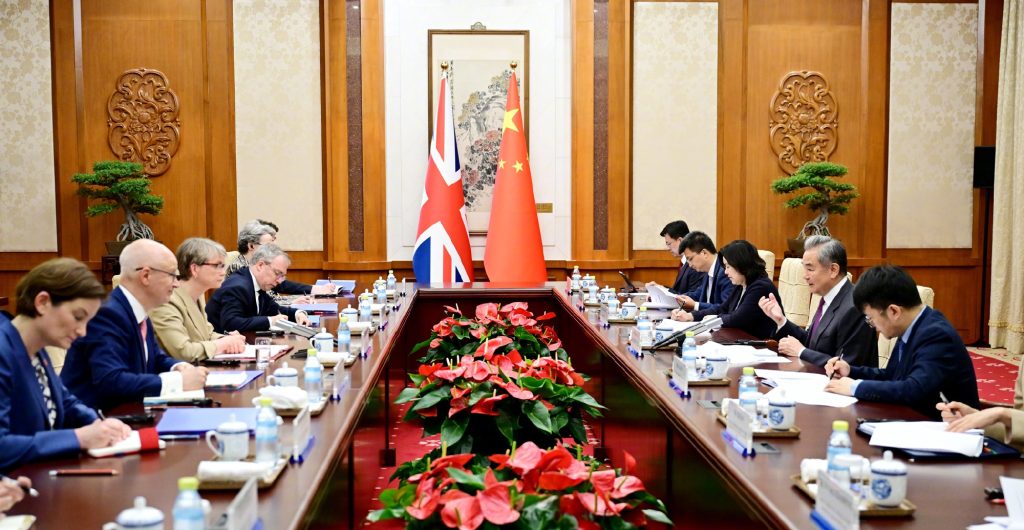
Chinese Foreign Minister Wang Yi on Tuesday said China hopes the British side will provide Chinese enterprises with a fair, just and non-discriminatory business environment, and foster a sound atmosphere for the development of bilateral ties and the deepening of cooperation between the two countries, according to the Xinhua News Agency.

Wang, also a member of the Political Bureau of the Communist Party of China Central Committee, made the remarks when holding the 11th China-UK Strategic Dialogue with UK Foreign Secretary Yvette Cooper in Beijing.

Noting that the leaders of both sides agreed to develop a long-term and consistent comprehensive strategic partnership when British Prime Minister Keir Starmer visited China at the beginning of this year, Wang said that at present, exchanges and cooperation in all fields between the two countries have been fully restored and are gradually getting back on track.

As permanent members of the United Nations Security Council, China and the UK should take the lead in following the right and impartial path, safeguard the fruits of victory in World War II, abide by the UN Charter, adhere to true multilateralism, and jointly promote the building of a more just and reasonable global governance system, Wang noted.

Cooper said that the long-term and consistent comprehensive strategic partnership is of great significance and in line with the interests of both sides. At a time when the international situation is turbulent and complex, it is more important than ever for the UK and China to strengthen dialogue and cooperation to jointly address global challenges, she added, according to Xinhua.

Since the establishment of diplomatic relations with China, the policy pursued by the UK on the Taiwan question has remained unchanged and will not change, Cooper said, adding that the British side is willing to continue to engage in candid dialogue with the Chinese side, handle differences constructively and properly, and promote the healthy and stable development of UK-China relations. 

Cooper's visit is widely seen as a follow-up to the consensus reached by the leaders of the two countries during Starmer's visit to China in January, with the aim of translating political understandings into concrete outcomes, Li Guanjie, a research fellow at the Shanghai Academy of Global Governance and Area Studies under the Shanghai International Studies University, told the Global Times on Tuesday. 

"Economic and trade cooperation remains the cornerstone of China-UK relations. Bilateral trade has remained steady in recent years, but maintaining that scale has become increasingly challenging amid global economic uncertainties. Against this backdrop, both sides are expected to focus on consolidating existing cooperation while exploring new growth areas, like science and technology cooperation, as the UK seeks to gain a better understanding of China's technological development and identify potential areas for future collaboration, Li said.

British media have also closely followed Cooper's visit. In a report published on Monday, the Independent said that Cooper had arrived in Beijing for in-depth talks on global security as the UK seeks to strengthen diplomatic relations with China.

Cooper's trip, which runs from Monday to Wednesday, includes visits to Beijing and Shenzhen in South China's Guangdong Province for a program focused on science and technology, according to Reuters. Cooper's visit is a "trip to focus on tackling global challenges," Reuters said.

Cooper's trip is understood to be aimed at building on previous Government visits with the most extensive senior foreign policy discussions since Labour came to power, said the Independent.

In another article published on Tuesday, the Independent noted that the UK government "sees engagement with major economies like China as key to protecting Britain's security at a time of heightened global instability, insisting the UK will cooperate where it can and challenge where it must."

At a time when geopolitical tensions, regional conflicts and protectionist tendencies continue to create uncertainties worldwide, maintaining dialogue and expanding areas of consensus between major countries could contribute to international stability, which is important for countries like China and the UK, Li said, adding that issues such as climate change, artificial intelligence and multilateral governance are likely to become important areas where the two sides can further deepen cooperation in the future.


China to encourage NEVs to be charged during off-peak power usage

China is set to promote the charging of new-energy vehicles (NEVs) during off-peak power usage by strengthening the interaction between NEVs and the power grids, with a relevant technical standard system established by 2025 and completed by 2030, several Chinese ministries jointly announced on Thursday.

By 2030, the interaction between China's NEVs and the power grid is expected to achieve large-scale application, facilitating the comprehensive promotion of intelligent and orderly NEV charging. The NEV-power grid interaction involves energy and information exchange through charging and discharging devices, enabling NEVs to participate in scenarios like virtual power plants.

According to an implementation suggestion released by four Chinese ministries, connecting NEVs to the power supply network can effectively leverage the flexible adjustment ability of vehicle power batteries as mobile energy storage.

Analysts highlight the significance of this suggestion, supporting the large-scale development of the NEV industry, the construction of new energy systems, and new power systems.

The suggestion sets a target that, by 2025, more than 80 percent of NEV power charged with private charging piles should be during off-peak power usage, with over 60 percent of NEV power charged in the off-peak period for the entire society in pilot cities.

Large-scale pilot demonstrations of NEV-power grid interaction are planned in regions such as the Yangtze River Delta, Pearl River Delta, Beijing-Tianjin-Hebei-Shandong region, Sichuan-Chongqing region, and other areas with favorable environments. Ministries aim to build more than five demonstration cities and over 50 two-way charging and discharging demonstration projects by the end of 2025.

In addition to the goal of charging NEVs during off-peak periods, the suggestion outlines six major tasks, including technological breakthroughs to extend battery lifetime and improvements in the market mechanism of electricity prices.

Furthermore, the suggestion encourages power suppliers to engage in the construction and servicing of charging facilities in residential areas. Power suppliers are also urged to build terminals integrating solar power generation, storage, and charging facilities based on local conditions, promoting the integrated development of transportation and energy generation.

China tour good starting point for restarting exchanges: Philadelphia Orchestra conductor

The Philadelphia Orchestra, which in 1973 became the first US orchestra to visit China, is back in Beijing for a concert with the China National Symphony Orchestra. The joint performance, which will take place on Friday, marks the 50th anniversary of their groundbreaking cultural exchange that helped improve relations between the two countries.

The two orchestras will be led by Li Xincao, the chief conductor of the China National Symphony Orchestra, and Tristan Rais-Sherman, the assistant conductor of the Philadelphia Orchestra.

Rais-Sherman, who joined the Philadelphia Orchestra two years ago, told the Global Times after Wednesday's rehearsal that he was honored to be part of this historic event. 

The concert, hosted by China's Ministry of Culture and Tourism and organized by the China Arts and Entertainment Group Ltd, will feature a blend of Western and Chinese music. 

Rais-Sherman added that he learned about the history of the Philadelphia Orchestra and China after the cooperation was confirmed nearly half a year ago.

"The Beethoven's Symphony No.5 we are going to play is actually historically connected to our visit as we first played it here in 1973. And we also have Tang Dynasty poetry songs and Erquan Yingyue, the choice of music is a blend of both, which is significant," he told the Global Times.

He also praised the cooperation with the China National Symphony Orchestra, saying it was fantastic to work with them for the first time.

"Every time working with a new orchestra, you don't know what would happen. We didn't really know each other at first. Everyone is finding each other and figuring things out from the beginning. However, by the end of today, the level here is very high. They (the Chinese orchestra) are very enthusiastic, flexible and they are great listeners," he said, adding that it was a privilege to be there.

"I hope that other American orchestras can continue to come back, and I hope this visit is a starting point of restarting the visits," he added. 

"To be a major part of this is a special experience to me."

The Philadelphia Orchestra, which arrived in Beijing on Tuesday with 14 members, will also hold master classes, panel discussions, and a chamber music performance in Shanghai as part of their tour, which will also include stops in Suzhou and other cities.