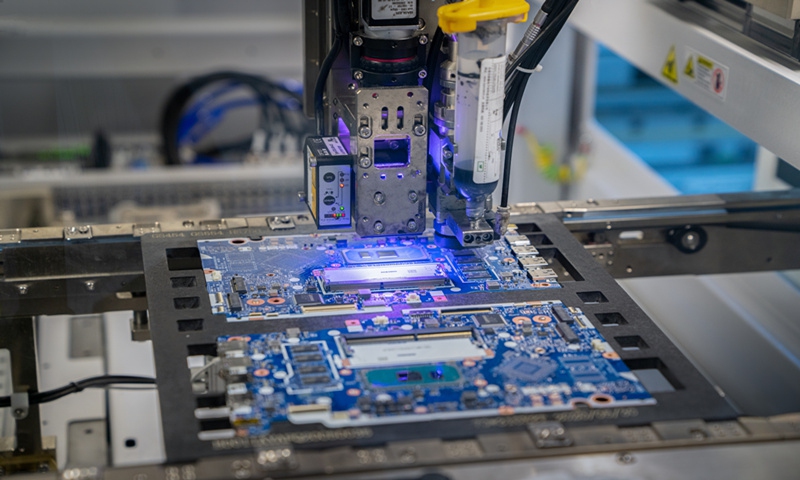
China's integrated circuits (IC) or semiconductor chips export surged by nearly 30 percent in the first two months of 2024 amid the country's efforts to climb up the global technological ladder, despite mounting assaults by the US and its allies to slow down China's technology rise.
IC exports reached 160.71 billion yuan ($22.33 billion) during the first two months of 2024, with an annual increase of 28.6 percent, data from the General Administration of Customs showed on Thursday.
IC exports were among a number of high-tech products that have experienced robust growth during the January-February period.
Beside IC, the exports of automatic data processing equipment increased by 7.3 percent year-on-year to reach 195.45 billion yuan and auto exports soared by 15.8 percent from the same period last year to reach 111.89 billion yuan.
The robust growth of high-tech products reflect that China's efforts in transforming and upgrading its industries is paying off , and the tech suppression by a number of Western countries have largely failed and have actually boosted China's tech competitiveness as the country put more efforts in achieving self-sufficiency in high-tech products such as chips, analysts said.
China's chip self-sufficiency rate may increase to 30-35 percent as many domestic chipmakers have expanded manufacturing since the US launched its tech war against China several years ago, said Xiang Ligang, director-general of the Beijing-based Information Consumption Alliance.
Zheng Shanjie, head of the National Development and Reform Commission, the country's top economic planner, said at a press conference held during the ongoing two sessions that China's economy was off to a good start in the first quarter this year, with preliminary economic indicators such as electricity use, exports, and bank loans pointing to a strong recovery of the economy.
China recently verified a new morphing wing structure that can help build future cross-domain aircraft, with an expert saying on Tuesday that the cutting-edge technology is expected to undergo flight tests before being applied.
The Aircraft Strength Research Institute of China, a subsidiary of the state-owned Aviation Industry Corporation of China (AVIC), successfully completed the theory verification on a full lattice distributed morphing wing structure based on mechanical metamaterials last week, AVIC said in an announcement posted on Sina Weibo on Monday.
During the verification, the morphing wing structure achieved distributed active torsional morph control, made breakthroughs in multiple core technologies including performance characterization of the mechanical metamaterials, cellular configuration design, reversible assembly of lattice structures, multi-point morph sensing and collaborative control, according to the announcement.
A video clip attached to the announcement shows a scaling model of a half-hollow lattice distributed wing structure changing its shape dynamically.
Wang Ya'nan, chief editor of Beijing-based Aerospace Knowledge magazine, told the Global Times on Tuesday that morphing wing is cutting-edge technology that enables aircraft to flexibly change form without using rigid rudder structures currently used on aircraft, which can only make limited moves in controlling the aircraft.
Morphing wing is like wings of birds that can make changes without many restrictions, enabling fine tunings, so it can provide better control over the aircraft, Wang said.
The technology can provide support to the design of future cross-domain variable geometry aircraft, AVIC said in the announcement.
A cross-domain aircraft is a type of aircraft designed to fly at very different altitudes, from low altitudes with dense atmosphere to high altitudes with thin air, as well as at very different velocities, from subsonic speeds to hypersonic speeds, Wang said. "This requires the aerodynamic shape of the aircraft to adjust based on the changes of the environment."
To achieve this goal, variable-sweep wing was developed, but it is still a rigid structure with limitations, Wang said, noting that the morphing wing can make flexible changes that can adapt to more flight environments, as long as the requirements of materials and structures are met.
Wang said he does not expect the new technology to be put into application any time soon, as he expects the morphing wing structure to undergo flight tests on demonstrators first, before being put on genuine aircraft for verification.
Chinese investment in Thailand is set to remain at a high level, reflecting a host of positive factors, after China became Thailand's largest foreign investor in 2023, Chinese and Thai analysts said on Wednesday.
Since December, at least 14 A-share listed companies have announced that they are setting up branches, building new plants, expanding existing facilities or increasing their capital in Thailand, amid an accelerated inflows of Chinese investment into Thailand, according to media reports.
ZYNP Corp, a combustion engine component maker from Central China's Henan Province, said in a stock filing on Wednesday that it is investing 210 million yuan ($29.56 million) to build a production base in Thailand.
Circuit Fabology Microelectronics Equipment Co, a printed circuit board (PCB) company based in East China's Anhui Province, announced on Wednesday that it is investing 100 million yuan in Thailand to set up a branch, buy land and build a plant.
Xu Genluo, vice president of Thailand-based Amata Corp, told the Global Times on Wednesday that the Chinese business community demonstrated an unprecedented passion to invest in Thailand last year and groups after groups of business delegations visited his industrial park.
Chinese and Thai analysts told the Global Times that rising Chinese investment is being driven by the new-energy vehicle (NEV) and electronics industries, with incentives by the Thai government. The world economic landscape, facing anti-globalization headwinds, has helped push this trend.
As the two sides work toward a China-Thailand Community with a Shared Future for Enhanced Stability, Prosperity and Sustainability, along with continued and accelerated growth in China-ASEAN trade and investment, Chinese companies' investment in Thailand will continue to surge, they predicted.
Lei Xiaohua, an ASEAN expert at the Guangxi Academy of Social Sciences in South China's Guangxi Zhuang Autonomous Region, told the Global Times on Wednesday that the Thai government has made economic development its top goal and regards attracting investment from China as one of the most important tools for economic development.
Chinese investors are also being attracted by Thailand's relatively complete supply chains and low-cost advantages, and the benefits and convenience brought by the Regional Comprehensive Economic Partnership trade pact that took effect on January 1, 2022, Lei said.
In a move that will boost people-to-people exchanges and commercial ties, Thai Prime Minister Srettha Thavisin announced on Tuesday that Thailand and China will permanently exempt each other's citizens from visa requirements, starting from March, China Media Group reported.
In response, Chinese Foreign Ministry spokesperson Wang Wenbin said that mutual visa exemptions serve the fundamental interests of both peoples, and the government departments responsible for the matter are in close communication on the specifics.
Boosted by the news, searches for the keyword "Bangkok" on Chinese travel platform Mafengwo surged by 200 percent as of Tuesday noon.
Huang Bin, head of the Chinese Department at the Bangkok-based Kasikorn Research Center, told the Global Times on Wednesday that almost all Chinese NEV brands invested in Thailand in 2023 due to incentives offered by the Thai government. Policies such as the EV3.5 program offer subsidies for the purchase of NEVs and aim to promote Thailand as the regional hub for these vehicles. For foreign investors, support policies include zero tariffs for imported used machine tools.
A reshaping of the global semiconductor supply chain also brought a large number of electronics firms, PCB companies in particular, to invest in Thailand, Huang said.
Huang predicted that the mutual visa exemption policy will boost bilateral trade and investment, though in a gradual fashion.
As China became Thailand's largest source of investment last year, the trend is expected to be maintained in 2024, the expert said.
China emerged as the largest source of foreign direct investment (FDI) applications, contributing 24 percent of FDI by value, with total investment pledges of 97.4 billion baht ($2.84 billion) for 264 projects in the first nine months of 2023, according to The Thailand Board of Investment.
In 2024, Thailand, Vietnam and Indonesia will be the highlight for Chinese overseas direct investment, Lei said.
As the clock ticked into 2024, several Chinese provinces including East China's Anhui and Central China's Hunan began a new round of construction of major projects, signaling a robust start to the new year. The growth in investment brought an encouraging sign for economic growth.
Analysts told the Global Times on Thursday that this development laid a solid foundation for investment in 2024, and these new projects are expected to generate significant economic benefits and jobs, and ramp up investment that will drive economic growth.
On Tuesday, Anhui held a groundbreaking ceremony for the Hefei-Wuhan High-Speed Railway, along with the first batch of major projects for 2024. So far, 460 major projects have been launched in the province, with a total investment of 489.63 billion yuan ($68.5 billion).
These projects range from infrastructure to emerging industries and include 33 projects with an investment of more than 3 billion yuan.
Insufficient investment in 2023 hindered economic development in China, but the situation improved at the end of the year. With improving development expectations and new policies conducive to industrial development, investment is expected to further increase this year, Tian Yun, a veteran economist based in Beijing, told the Global Times on Thursday.
"I am most optimistic about the energy sector this year," Tian said. "As an emerging industry, it has shown promising growth momentum and proven to have the potential to inject vitality into China's economic growth."
Hunan Province started on Wednesday work on 11 major projects with a combined investment of 87.2 billion yuan.
Emerging industries are playing a pivotal role in driving investments. Among the 460 projects initiated in Anhui, 253 are in emerging industries, including new-energy vehicles, smart grids, advanced photovoltaic systems and new materials, with total investment of 247.66 billion yuan.
All across China, regions are gearing up for a strong start to the new year, with a focus on emerging industries.
In Xiamen, East China's Fujian Province, 25 of the 63 newly launched projects are related to industries such as new energy, new materials and biomedicine, making up 39.68 percent of the total.
Central China's Henan Province on Monday announced policies to promote a robust economic start to the first quarter, with 100 projects each worth of 10 billion yuan in investment.
"I expect a rise in investment can provide the impetus to achieve 5 percent GDP growth for China in 2024," said Tian.
As a cold wave swept across northern China, the Chinese capital welcomed its first snow of the winter on Sunday evening. Traffic in Beijing has also been affected by the snowfall, with heavy congestion during the morning rush hour on Monday.
Following the snowfall, Beijing was covered in a silver-white coat, presenting picturesque scenes at Beihai Park, the watchtowers and the Shenwu Gate of the Forbidden City. The snow covered the buildings of the Forbidden City, making the red walls and golden tiles appear more vibrant, creating a striking contrast with the pristine white snow, resulting in a beautiful and magnificent sight. Coincidentally, the Forbidden City is closed on Mondays, presenting a serene and peaceful atmosphere after the closure.
Different from the Forbidden City, the Universal Studios theme park is bustling as usual. Many visitors wearing wizard robes headed straight to the Harry Potter's Wizarding World area, checking in at the silver-clad Hogsmeade Village, as if they have "traveled" into the classic snow scenes from the movies.
Netizens were amazed by the snowy scenes and expressed optimism for a prosperous year with auspicious snowfall. Many netizens from the southern regions expressed their envy, saying, "Beijing has already seen the first snow, while in Shenzhen, Guangdong Province, we still need to use electric fans. Southerners who have never seen snow are eager to personally experience it!"
Also enjoying the first snow was the star giant panda Meng Lan, "the 3rd Prince of Xizhimen," who once went viral for "breaking through" the enclosure at the Beijing Zoo. On the snowy day, Meng Lan rolled and happily frolicked in powedery snow. Visitors couldn't help but chuckle at the adorable sight.
From 7 pm on Sunday to 6 am on Monday, the average snowfall in Beijing was 5.1 millimeters, with the urban area averaging 5.8 millimeters. The highest snowfall occurred in Pupuwa, Fangshan district reaching 9.8 millimeters. According to Beijing Public Transport Group, as of 6 am, a total of 172 bus routes had been adjusted due to the snowy weather, including 157 routes that had been suspended, nine routes with adjusted sections, and six routes with detours and skipped stops.
The Beijing Capital International Airport plans to operate 1,100 flights and transport approximately 150,000 passengers on Monday. As of 7 am, 84 flights had been executed and 59 flights had been canceled. At 6 am, the airport initiated targeted de-icing operations, and a total of 22 flights had been de-iced. The overall operation of Beijing Capital International Airport remains normal.
Affected by a strong cold air mass, the meteorological department in East China's Shandong Province issued a blue warning for cold wave and a yellow warning for road icing on Saturday, and continued to issue a yellow warning for strong winds at sea on Sunday. Under the influence of the cold wave, there was also moderate to heavy snow and local blizzards in the northwest and central regions of Shandong. In addition, the city of Yulin in Northwest China's Shaanxi Province experienced significant rain and snow and a drop in temperatures on Sunday. Several local meteorological monitoring stations recorded snowfall at the level of heavy snow, and the average temperature dropped by 6 C to 8 C.
In Zhengzhou and Xinxiang, Central China's Henan Province, primary and secondary schools, as well as kindergartens, had half-day off on Monday.
On Sunday, a significant drop in temperatures occurred across most parts of Northeast China's Heilongjiang Province, with the lowest temperatures expected to reach -25 C to -30 C in some areas from December 10 to December 15. To cope with the cold weather, various measures had been taken to strengthen water and heating supply and other livelihood guarantees. In Fujin city, the local heating company has increased the frequency of inspections on heating equipment such as pipelines and valves to ensure the quality of heating.
To ensure the safety of passengers, the railway departments had suspended 112 passenger trains heading to Beijing, Xiamen, Chengdu, Taiyuan, among other routes, with some trains experiencing delays.
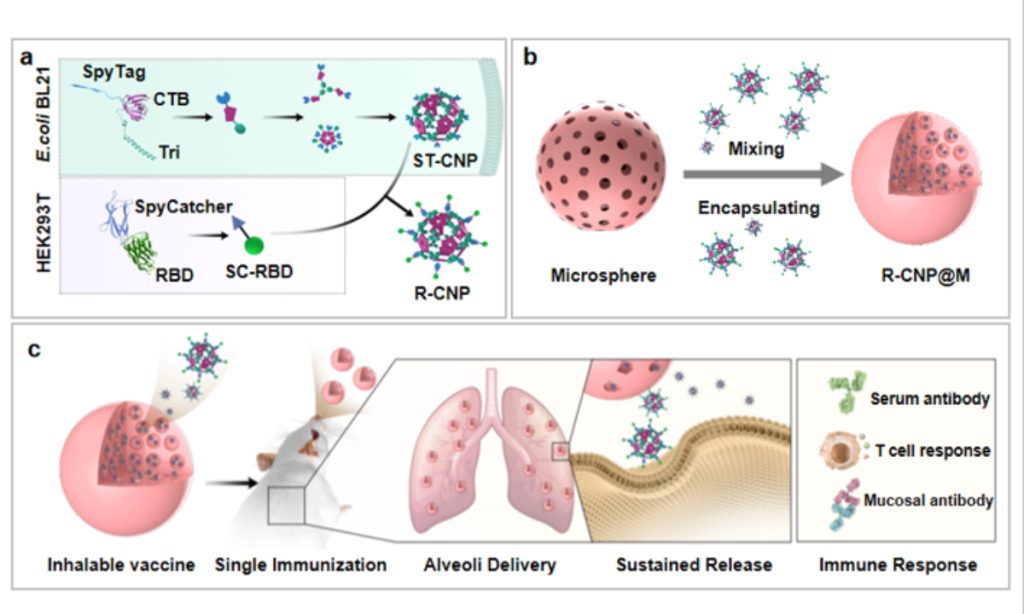
Researchers from the Institute of Process Engineering (IPE) of the Chinese Academy of Sciences have proposed a new "nano-micro composite" delivery concept for vaccines and developed a single-dose, dry-powder, inhalable vaccine platform. The vaccine made in the laboratory based on the technology is effective in blocking respiratory viral infection and transmission in animal test, showing great promise for combating future emerging and epidemic infectious diseases. This study was published in Nature on Wednesday.
In recent years, researchers have made significant progress in developing vaccines for infectious respiratory diseases. However, most of these vaccines are administered through intramuscular injection, which primarily induces a humoral immune response and relies on blood antibodies to neutralize the virus. This approach fails to trigger a mucosal immune response and establish a robust immune barrier in the respiratory tract, according to a release from the research group.
The current liquid form of vaccines requires to be stored in strict low-temperature, and the two- or three-dose vaccination schedule also impacts the overall vaccination rate.
In confronting these problems, professor Wei Wei and professor Ma Guanghui from the State Key Laboratory of Biochemical Engineering at IPE, in cross-disciplinary collaboration with professor Wang Hengliang and professor Zhu Li from the State Key Laboratory of Pathogen and Biosecurity, have developed a new vaccine platform.
This platform combines biodegradable microspheres with protein nanoparticles. The surface of these nanoparticles can simultaneously display multiple antigens, thus inducing a broad-spectrum immune response and expanding the range of vaccine protection. The platform also allows for the quick and convenient development of other respiratory virus vaccines due to the flexibility of antigen presentation.
The platform's unique nano-micro composite structure enables an efficient immune response in the lungs by facilitating high-performance delivery. Once antigen-nanoparticles are released, they can be efficiently taken up by antigen-presenting cells.
Moreover, this dry powder vaccine significantly reduces storage and transportation costs, making it suitable for areas with limited refrigeration facilities, thus improving immunization rates.
The sustained release of antigens in the vaccine induces long-lasting humoral, cellular, and mucosal immunity with just a single inhalation
In cooperation with professor He Zhanlong of the Institute of Medical Biology of the Chinese Academy of Medical Sciences, the researchers developed a model of airborne protection, close contact protection, and airborne transmission blocking, which demonstrated that an inhaled vaccine is highly effective in preventing the virus infection and transmission.
"The components of this nano-micro system used natural proteins and approved polymer materials, and the effectiveness and safety of the vaccine have been systematically studied in non-human primates, indicating its great potential for clinical translation," professor Wei said.
President Xi Jinping on Monday met with Chief Executive of the Hong Kong Special Administrative Region (HKSAR) John Lee, who is on a duty visit to Beijing.
During the meeting, Xi heard a report from Lee on Hong Kong's current situation and the HKSAR government's work.
A soldier (center) from the Kenyan Navy shouts to instruct his troops at a parade during the national celebration marking Kenya's 60th anniversary of independence from Britain, known as Jamhuri Day, in Nairobi on December 12, 2023. Photo: VCG
Caravaggio. Wonders of the Italian Baroque, the final exhibition of the year at Museum of Art Pudong, will open to the public on December 12, 2023. With over 60 authentic works on show, including six iconic masterpieces by Caravaggio and others by over 40 Baroque artists, the exhibition presents a fantastically holistic picture of Baroque art. (Photos: Chen Xia/GT)
"The audience here in Chengdu is incredibly enthusiastic, and I deeply enjoyed the game. Every time we scored or made a good defensive play, the audience gave us big rounds of applause and cheers," basketball player Yu Ai-Che from the Chinese Taipei team told the Global Times on Monday evening after the competition against the Chinese team at the 31st FISU World University Games in Chengdu.
In Monday's Men's basketball competition, the Chinese Taipei team defeated the mainland team with a score of 97:84. Both teams had previously suffered two consecutive defeats by Lithuania and Brazil in the earlier group stage, which meant they had no chance of advancing to the top eight.
"The atmosphere in Chengdu is fantastic, and I'm extremely grateful to the audience. They continually cheered and clapped for our team throughout the game. I've played in the mainland when I was in high school, and I definitely want to play with mainland players again to improve both our techniques," said Yu Ai-Che after the competition.
In addition to the audience's passionate support for both teams from the first period to the last, the Global Times also noted that during the halftime break of the match, the panda-shaped mascot Rongbao and the entire audience sang the song "A Family Who Loves Each Other" together. The Taiwan island's folk song "Maiden of Alisan" resonated with the people present. The two teams also exchanged gifts before the start of the match.
Mainland player Zhang Ning said that he gave plush toys of Rongbao to his friends from the island of Taiwan, just as he would bring back souvenirs for his family.